Fence & Mailbox Posts concrete calculator
Enter your dimensions — we'll size the load with a 10% waste factor. Typical fence & mailbox posts order: ~1.5 yd³.
How much concrete do you need?
Pick your project shape — we'll size the load.
Join the priority list
Typical pricing by email today — and we’ll text you the moment your area opens. No account needed.
How the math works
π × (hole diameter ÷ 2)² × depth × number of holes × 0.9 ÷ 27 = cubic yards
- 1 Each hole is a cylinder: π times the radius squared times the depth, in feet.
- 2 Multiply by the number of holes, then by 0.9 — the post itself displaces about a tenth of the hole.
- 3 Divide by 27 to get cubic yards.
- 4 Add 10% waste for over-dug holes and round up to the quarter yard.
How to use this calculator
- 1 Measure the pour. Count the post holes and measure hole diameter and depth in inches (10 × 24 in is typical for a 6 ft fence).
- 2 Enter the dimensions. Type the numbers into the fence & mailbox posts calculator — it converts units and divides by 27 to get cubic yards.
- 3 Check the waste factor. The result includes 10% waste for uneven ground and spillage, rounded up to the quarter yard (1 yd³ minimum).
- 4 Price the delivery. Send the yardage with your ZIP code to get an all-in delivered price — metered trucks bill only what's actually poured.
Typical fence & mailbox posts quantities
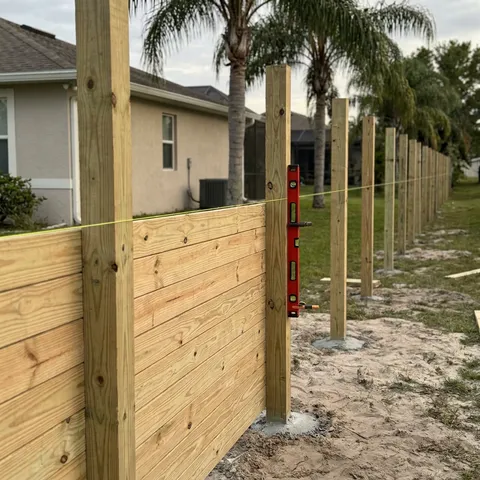
Typical fence runs with 10 in holes dug 24 in deep (the Florida rule of thumb: bury 1/3 of the post height):
| Posts | Hole size | Volume | Order (with waste) |
|---|---|---|---|
| 10 posts | 10 × 24 in | 0.36 yd³ | 1 yd³ |
| 20 posts | 10 × 24 in | 0.73 yd³ | 1 yd³ |
| 30 posts | 10 × 24 in | 1.09 yd³ | 1.25 yd³ |
| 50 posts | 10 × 24 in | 1.82 yd³ | 2 yd³ |
Short runs land on the 1-yard minimum — pouring posts and a small pad in the same visit uses the yard fully.
Common ordering mistakes
-
Counting posts, not holes
Gates, corners and end posts often get bigger holes or doubled posts. Count the actual holes at their actual sizes.
-
Forgetting the post displaces concrete
The post takes up roughly a tenth of the hole — the calculator already subtracts it, so don't discount twice.
-
Uniform holes in non-uniform ground
Sandy spots dig wider and storm-zone runs need deeper holes. If a stretch of the fence line is different, size it separately and add the results.
Frequently asked questions
How accurate does my estimate need to be?
Close is enough: metered trucks bill the actual yards poured to the nearest quarter yard. The calculator adds a 10% waste factor so you don't come up short.
Which mix should I use for fence & mailbox posts?
Fence Post Mix (2500-3000 PSI) is the standard recommendation for fence & mailbox posts. Economical mix metered directly into post holes — no bags, no mixing, no waste. Ideal for fence runs and mailbox posts.
How deep should fence post holes be in Florida?
The rule of thumb is 1/3 of the post height buried — 24 in for a 6 ft fence — with 10–12 in diameter holes. In hurricane zones, deeper holes and more concrete per post are what keep the fence up.
Delivered pricing by city
Related calculators & tools
Next step: read the Fence & Mailbox Posts guide or get your delivered price with the button above.