Driveway Aprons & Extensions concrete calculator
Enter your dimensions — we'll size the load with a 10% waste factor. Typical driveway aprons & extensions order: ~3 yd³.
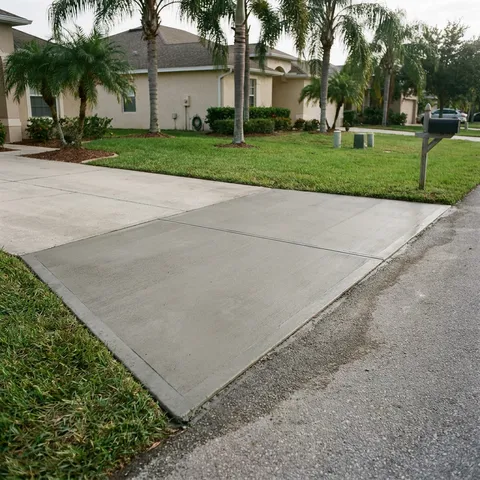
How much concrete do you need?
Pick your project shape — we'll size the load.
Join the priority list
Typical pricing by email today — and we’ll text you the moment your area opens. No account needed.
How the math works
length (ft) × width (ft) × thickness (ft) ÷ 27 = cubic yards
- 1 Multiply length by width in feet to get the area of the pour.
- 2 Convert thickness to feet (4 in = 0.33 ft) and multiply — that gives cubic feet.
- 3 Divide by 27 (the cubic feet in one cubic yard) to get cubic yards.
- 4 Add 10% waste for uneven ground and spillage, then round up to the quarter yard.
How to use this calculator
- 1 Measure the pour. Measure the length and width of the pour in feet, and pick the thickness in inches (4 in is typical).
- 2 Enter the dimensions. Type the numbers into the driveway aprons & extensions calculator — it converts units and divides by 27 to get cubic yards.
- 3 Check the waste factor. The result includes 10% waste for uneven ground and spillage, rounded up to the quarter yard (1 yd³ minimum).
- 4 Price the delivery. Send the yardage with your ZIP code to get an all-in delivered price — metered trucks bill only what's actually poured.
Typical driveway aprons & extensions quantities
Common apron and extension sizes at 6 in — the street end takes vehicle turning loads:
| Apron size | Thickness | Volume | Order (with waste) |
|---|---|---|---|
| 9 × 8 ft | 6 in | 1.33 yd³ | 1.50 yd³ |
| 10 × 10 ft | 6 in | 1.85 yd³ | 2.25 yd³ |
| 12 × 15 ft | 6 in | 3.33 yd³ | 3.75 yd³ |
| 16 × 20 ft | 6 in | 5.93 yd³ | 6.75 yd³ |
Common ordering mistakes
-
Measuring the slab, not the forms
Measure inside the forms as they're actually set — a “10 × 12” driveway aprons & extension pour is whatever the forms enclose, and an inch each way moves the total.
-
Trusting the ground to be flat
Florida sand settles and over-digs. If the sub-base dips half an inch across the pour, that missing volume comes out of your load — grade and compact before the truck arrives.
-
Ordering the bare math
Skipping the waste factor is the classic way to come up half a wheelbarrow short. With a metered truck, rounding up costs nothing unless it's actually poured.
-
Mixing up inches and feet
Thickness is the usual culprit: 4 inches is 0.33 feet. Feed the calculator inches where it asks for inches and it handles the conversion.
Frequently asked questions
How accurate does my estimate need to be?
Close is enough: metered trucks bill the actual yards poured to the nearest quarter yard. The calculator adds a 10% waste factor so you don't come up short.
Which mix should I use for driveway aprons & extensions?
4000 PSI Structural Mix is the standard recommendation for driveway aprons & extensions. Higher-strength mix for driveways with heavy loads, footings, equipment pads and structural work.
How thick should a driveway apron be?
6 inches at the street end, where vehicles turn and brake — many Florida counties require it in the right-of-way. 4000 PSI is the standard mix for anything that carries vehicles.
Delivered pricing by city
Related calculators & tools
Next step: read the Driveway Aprons & Extensions guide or get your delivered price with the button above.